SSAS Member Benefits: How Directors Draw Retirement Income
Written by Matt Lenzie
Former Banker & Corporate Finance Partner

When Can You Take SSAS Benefits?
SSAS benefits can currently be taken from age 55 (rising to 57 in April 2028). There is no obligation to retire or cease employment when you begin drawing benefits — you can take income from your SSAS while continuing to work and make further contributions.
The flexibility of benefit drawdown is one of the SSAS's significant advantages over traditional defined benefit pensions. Members are not locked into a fixed income from a specific date. Instead, they can take income in a flexible, tax-efficient manner that suits their personal circumstances and retirement plans.
Pension Commencement Lump Sum (PCLS)
The first decision most SSAS members face when accessing their pension is whether to take a Pension Commencement Lump Sum (PCLS) — commonly known as a tax-free cash lump sum. Up to 25% of the member's pension fund (subject to a maximum of £268,275 as of 2024/25) can be taken as tax-free cash at the point of crystallisation.
The PCLS is a one-off opportunity at crystallisation — you cannot defer and take it later. Taking a PCLS reduces the fund available for income drawdown, so the decision requires careful financial modelling. In some cases, not taking the full PCLS makes more sense if the pension fund will continue to grow significantly.
Flexi-Access Drawdown
The most common approach for SSAS members is flexi-access drawdown (FAD). After taking any PCLS, the remaining fund is "designated for drawdown" and the member can withdraw income at any level they choose, at any frequency, with income taxed at their marginal rate.
Key features of FAD in an SSAS:
- Flexible income: You choose how much to draw and when — there is no minimum or maximum income requirement under FAD (unlike the old capped drawdown rules)
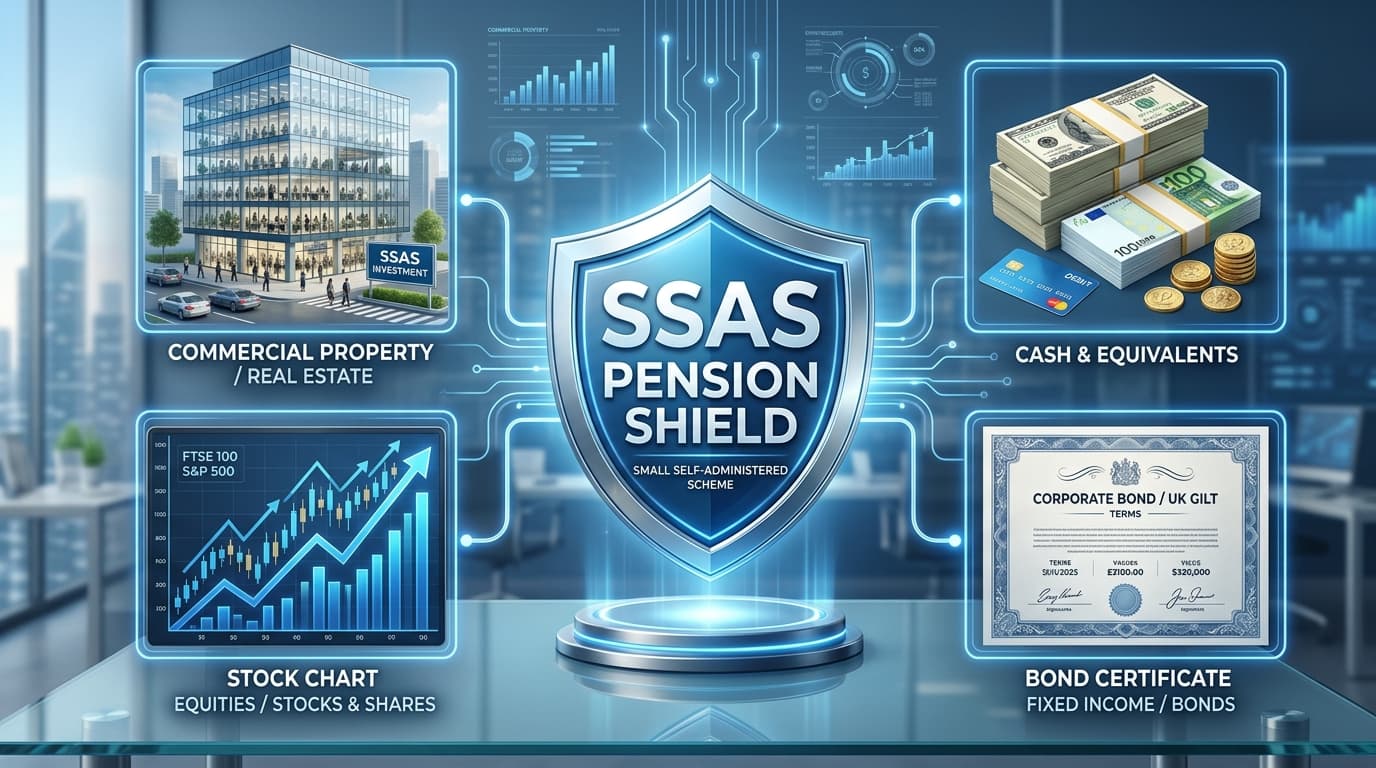
- Investment control: Funds remain invested in SSAS assets (potentially including commercial property) while in drawdown, continuing to grow tax-free
- Death benefits: Funds remaining on death can generally be passed to nominated beneficiaries free of inheritance tax (though income tax applies to funds drawn above the age of 75)
- Money Purchase Annual Allowance: Once you take any flexible income from a money purchase arrangement, the Money Purchase Annual Allowance (MPAA) of £10,000 applies to further money purchase contributions
Matt Lenzie notes: "For directors whose company is still growing, the ability to draw modest income from the SSAS while leaving the bulk of the fund invested is enormously valuable. You are not forced to wind down your investment strategy just because you have reached retirement age."
Annuity Purchase
A member can use their SSAS fund (or part of it) to purchase a lifetime annuity from an insurance company. An annuity provides a guaranteed income for life, removing longevity risk. However, annuities are generally irreversible and, at current rates, may offer relatively modest income for the capital invested.
In practice, very few SSAS members opt for annuity purchase as their primary benefit strategy, given the flexibility that drawdown offers. Some members use part of their fund to buy a fixed income annuity while leaving the majority in drawdown.
Uncrystallised Funds Pension Lump Sums (UFPLS)
An alternative to the PCLS/drawdown route is taking Uncrystallised Funds Pension Lump Sums (UFPLS). Under this approach, the member takes a lump sum directly from uncrystallised pension funds, of which 25% is tax-free and 75% is taxed as income. This can be useful for one-off capital requirements but triggers the MPAA on future contributions.
Death Benefits
The death benefit planning opportunities within an SSAS are one of its most compelling features, particularly for business owners with estate planning concerns.
Death Before Age 75
If a member dies before age 75, any uncrystallised or drawdown funds can be paid to nominated beneficiaries entirely free of income tax. The payment can be in the form of:
- A lump sum death benefit (tax-free)
- A successor's drawdown fund (the beneficiary continues to draw income tax-free)
- An annuity for a dependant or nominee
Death After Age 75
If a member dies at 75 or over, lump sum and drawdown payments to beneficiaries are taxed at the beneficiary's marginal income tax rate. The inheritance tax exemption (SSAS funds fall outside the estate) still applies.
Inheritance Tax Position
Pension funds — including SSAS assets — do not currently form part of a member's estate for inheritance tax purposes. This makes the SSAS a powerful tool for passing wealth to the next generation tax-efficiently. Note that the government has proposed changes to the inheritance tax treatment of pension funds from April 2027; specialist advice should be taken on this evolving area.
Expression of Wishes
Members should complete an expression of wishes form, nominating who should receive death benefits. As pension death benefits are technically at the trustees' discretion, the expression of wishes is not legally binding — but trustees will normally follow it. Keeping this document up to date (after marriage, divorce, or changes in family circumstances) is important.
Phased Retirement
One of the most tax-efficient drawdown strategies for SSAS members is phased retirement — crystallising a portion of the pension fund each year rather than all at once. This allows the member to take a series of smaller PCLS payments (each being 25% of the crystallised segment) spread over multiple tax years, potentially reducing the income tax impact of drawing the pension.
Drawing Benefits While the SSAS Holds Property
A common practical question is how benefits can be drawn when the SSAS's main asset is illiquid commercial property. The answer depends on the scheme's cash position. If the SSAS has sufficient cash reserves, drawdown income can be paid from those reserves. If all assets are in property, the trustees may need to:
- Ensure there is a cash buffer within the scheme for benefit payments
- Arrange for rental income to flow through to drawdown distributions
- Potentially arrange a partial sale of the property if a major lump sum is required
This is a reason why having an appropriate cash allocation within the SSAS — even when the primary investment is property — is important from a benefit payment perspective.
Planning Ahead for Benefits
Effective benefit planning for an SSAS typically involves working with a regulated financial adviser to model:
- The projected fund value at intended drawdown age
- The optimal level of PCLS vs drawdown income
- The interaction of SSAS income with other income sources in retirement
- The inheritance tax and death benefit planning implications
If you are building your SSAS primarily around commercial property investment and want to understand how the finance side works, contact our team or explore our SSAS property finance page.
"The flexibility of SSAS benefit drawdown is genuinely remarkable compared to the pensions most directors grew up with. The ability to take variable income from a fund that continues to hold and generate rental income from commercial property is a retirement model that simply was not available to previous generations."
— Matt Lenzie, Former Banker & Corporate Finance Partner
Key Takeaways
- SSAS benefits can currently be taken from age 55 (57 from April 2028) without ceasing employment
- Up to 25% of the fund (max £268,275) can be taken as a tax-free PCLS at crystallisation
- Flexi-access drawdown allows completely flexible income withdrawal with funds remaining invested
- Death benefits can be passed to nominated beneficiaries, free of inheritance tax and (before age 75) income tax
- Phased retirement is a tax-efficient drawdown strategy unique to larger pension arrangements
- Property-heavy SSASs require cash management planning to ensure benefit payments can be made
About the Author
Matt Lenzie
Former Banker & Corporate Finance Partner
Matt Lenzie is a former banker and corporate finance partner with extensive experience in pension-backed property transactions. He founded SSAS Property Finance to help company directors and trustees navigate the complexities of commercial property acquisition through Small Self-Administered Schemes.