SSAS Deposit Requirements: How Much Cash Does Your Scheme Need?
Written by Matt Lenzie
Former Banker & Corporate Finance Partner
What Deposit Does an SSAS Need for Property?
When an SSAS borrows to purchase commercial property, the deposit represents the difference between the purchase price and the lender's maximum advance. Understanding how much your scheme needs — and where it can come from — is fundamental to structuring any SSAS property acquisition.
In our experience, deposit requirements are often the binding constraint for SSAS property deals. The HMRC borrowing cap may theoretically allow significant borrowing, but if the scheme lacks sufficient liquid assets for the deposit, the transaction stalls.
Typical LTV Ratios and Implied Deposit Requirements
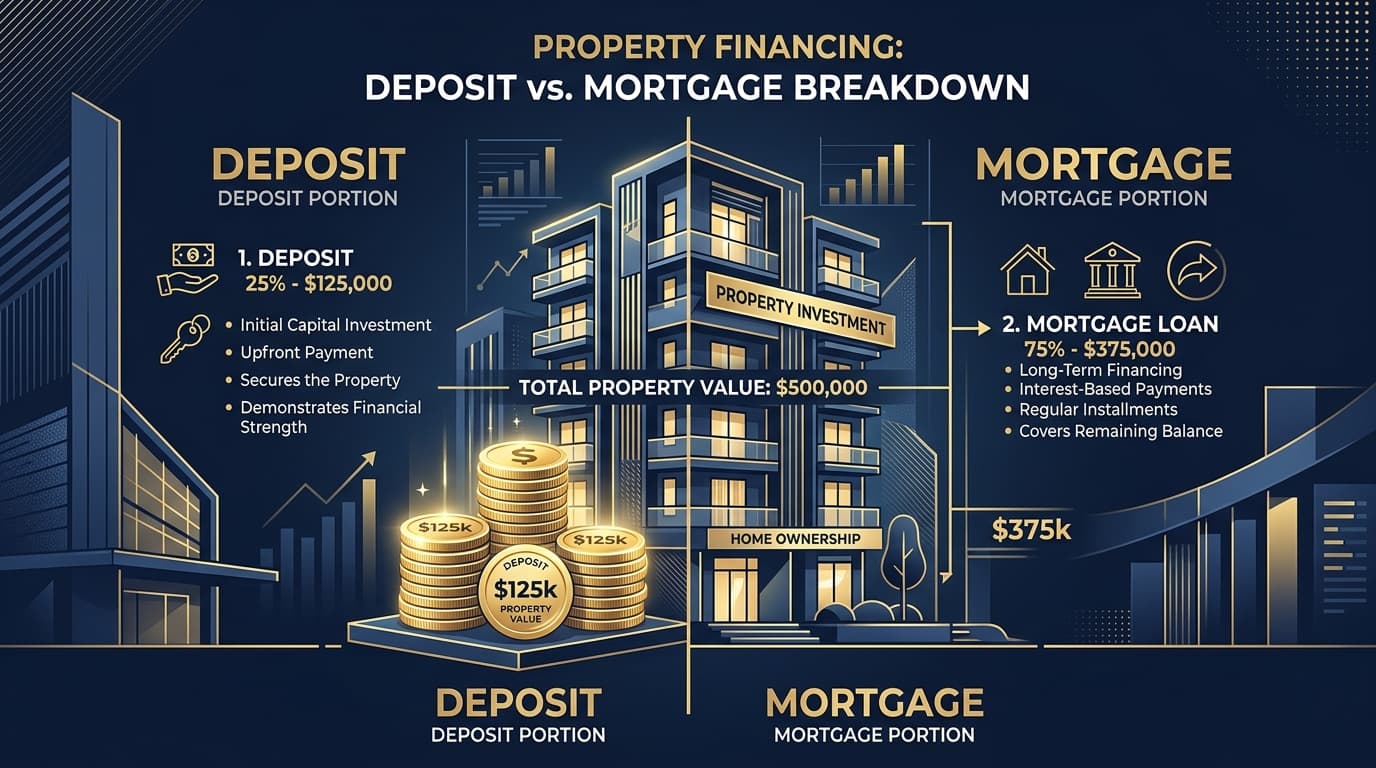
Most specialist SSAS lenders offer LTV ratios of 65-75% against the property value. This means your scheme needs to fund the remaining 25-35% from its own resources. In practice:
- 70% LTV lender = 30% deposit required
- 65% LTV lender = 35% deposit required
- 75% LTV lender = 25% deposit required (available from some lenders for stronger assets)
On a £500,000 property at 70% LTV, your scheme would need £150,000 as a deposit plus additional funds to cover transaction costs.
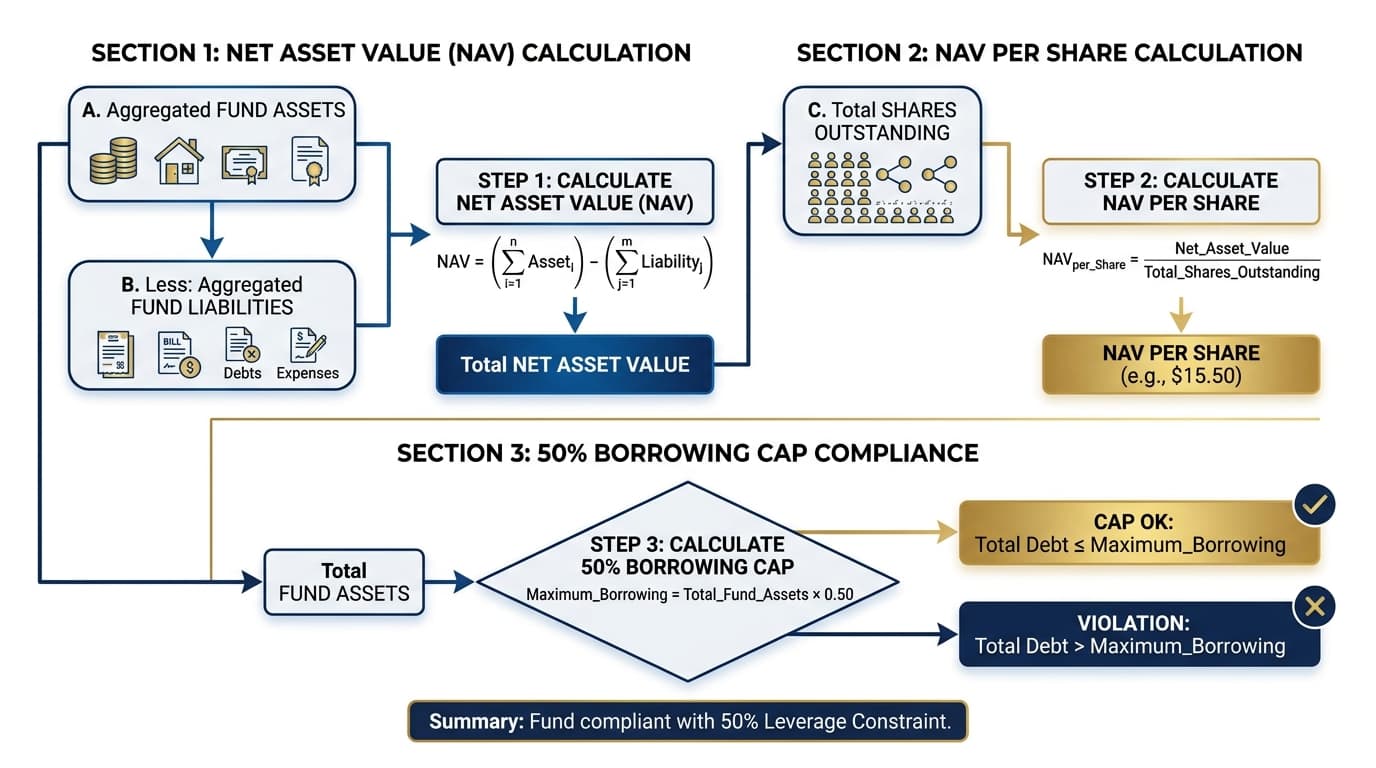
To understand your maximum borrowing in the context of the HMRC rules, see our guide to the SSAS 50% LTV cap.
Transaction Costs to Budget For
Beyond the deposit itself, the scheme must fund a range of transaction costs that can add 3-7% to the total capital required:
- Stamp Duty Land Tax (SDLT): Commercial property SDLT starts at 2% above £150,000 and rises to 5% above £250,000. For a £500,000 property, SDLT would be approximately £14,500
- Legal fees: Expect £3,000-£8,000 for SSAS-specialist solicitors covering both the purchase and the mortgage
- Valuation fee: £1,500-£3,500 for the lender's RICS valuation
- Mortgage arrangement fee: Typically 1-2% of the loan amount
- SSAS administrator fees: For trustee meeting minutes, due diligence, and transaction oversight
- Surveyor/structural survey: Optional but recommended, £1,000-£3,000
Matt Lenzie notes: "We always advise clients to budget an additional 5% of the purchase price for transaction costs. Being caught short at completion because costs were underestimated is an avoidable problem."
Acceptable Sources of Deposit Funds
The deposit must come from the SSAS itself — not from member personal funds paid directly to the vendor. Acceptable sources include:
1. Existing Scheme Cash Balances
The most straightforward source. Many SSAS schemes hold significant cash balances accumulated through employer and employee contributions over years. These can be deployed directly as the deposit at completion.
2. Proceeds from Liquidating Scheme Investments
If the scheme holds stocks, bonds, or other investments, these can be liquidated to generate the deposit. Timing is important — allow sufficient time for investment sales to settle before the completion date.
3. New Member Contributions
Members can make additional pension contributions ahead of the purchase to increase scheme cash. This is subject to the annual allowance (£60,000 per member in 2025/26) and carry-forward provisions. For a four-member SSAS, coordinated contributions could generate up to £240,000 per year within allowances.
For a detailed look at how contributions increase borrowing capacity, see our guide to SSAS borrowing power calculation.
4. Employer Contributions
The sponsoring employer can make pension contributions to the scheme, subject to overall contribution limits and the "wholly and exclusively" test for corporation tax relief. Large employer contributions in the year of a property purchase are a common strategy for funding deposits.
5. Proceeds from Existing Property
If the scheme already owns property that is being refinanced or sold, the equity released can fund a new acquisition. This is particularly common when schemes outgrow their initial property and want to trade up.
What Cannot Be Used as the Deposit
It's important to understand what HMRC prohibits:
- Personal funds contributed directly to the vendor on behalf of the scheme (this would be treated as an unauthorised member benefit)
- Loans from members or directors to the scheme (other than through formal loanback mechanisms)
- Funds from associated but non-scheme sources
All deposit funds must demonstrably sit within the pension scheme before completion. Lenders will typically require evidence of cleared funds held in the scheme's bank account.
Bridging the Deposit Gap
What if your scheme doesn't have enough liquid assets for the deposit right now? There are several strategies:
Bridging Loans
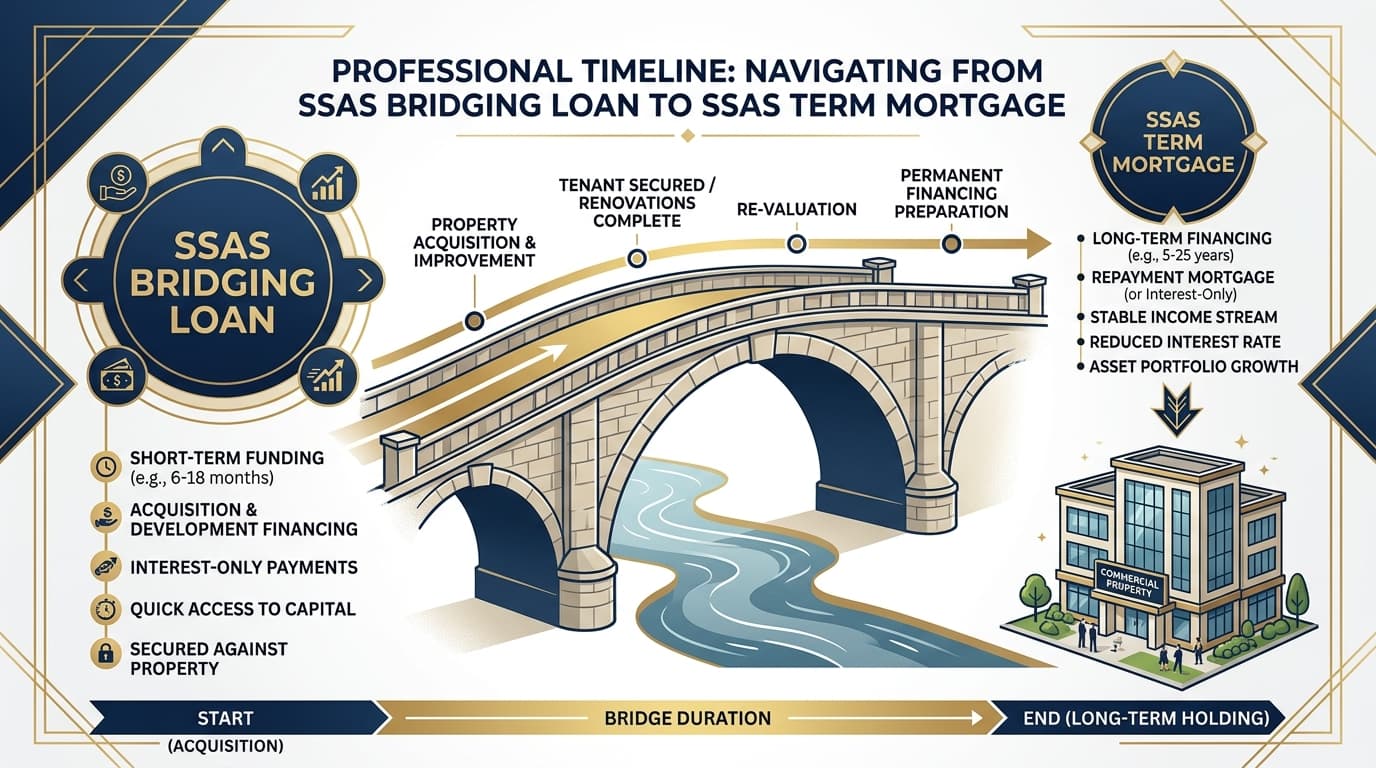
Some specialist lenders offer SSAS bridging loans that can be used to acquire a property quickly, with a term loan refinance to follow. The bridging facility can cover up to 75% of the property value, but the scheme still needs funds for the balance and costs. For more on this approach, see our guide to bridging to term loan for SSAS.
Phased Contributions Strategy
If the property is not yet under offer and there's time to plan, a phased contribution strategy can build up the scheme's deposit reserves over 1-2 years before purchasing.
Multiple Member Pooling
Pooling resources across multiple SSAS members significantly increases total deposit capacity. Four members each contributing £30,000 creates a £120,000 deposit pool without any single member feeling overstretched. See our guide to multiple member SSAS pooling.
Deposit Requirements vs. Affordability
Meeting the deposit requirement is just one hurdle. Lenders also need to be satisfied that the property generates sufficient income to service the mortgage. Even if your scheme has the deposit, a lender won't advance if the rental income is insufficient. The two tests work together:
- Deposit test: Does the scheme have the funds to cover 25-35% of the purchase price plus costs?
- Affordability test: Does the rental income cover the mortgage interest by 125-150%?
Both must be satisfied for a successful application. Our SSAS mortgage calculator can help you model both simultaneously.
Key Takeaways
- Typical SSAS deposit requirements are 25-35% of the property value, depending on the lender's LTV ratio
- Budget an additional 5% for transaction costs (SDLT, legal fees, valuation, arrangement fees)
- Deposits must come from within the scheme — new contributions, existing cash, or investment proceeds
- Bridging and phased contribution strategies can help schemes that lack liquidity today
- Meeting the deposit requirement alone is not enough — the rental income affordability test must also be passed
Assess Your SSAS Deposit Position Today
Our team can quickly assess whether your scheme has the deposit capacity for your target property and help you identify strategies to bridge any gap.
Get in touch for a confidential assessment, or explore your options on our SSAS property mortgage page.
About the Author
Matt Lenzie
Former Banker & Corporate Finance Partner
Matt Lenzie is a former banker and corporate finance partner with extensive experience in pension-backed property transactions. He founded SSAS Property Finance to help company directors and trustees navigate the complexities of commercial property acquisition through Small Self-Administered Schemes.