What Is an SSAS Pension? A Complete Guide for Business Owners
Written by Matt Lenzie
Former Banker & Corporate Finance Partner

What Is an SSAS Pension?
A Small Self-Administered Scheme — universally known by its acronym SSAS — is a type of occupational pension trust established by a company for the benefit of its directors and key employees. Unlike a SIPP (Self-Invested Personal Pension), an SSAS is a company-sponsored arrangement, meaning it exists within the corporate structure of the business rather than as a purely individual vehicle.
SSAS pensions have been available in the UK since the 1970s and are regulated by HMRC and, for schemes with more than one member, the Pensions Regulator. They typically have between 2 and 11 members, though a single-member SSAS is permissible. Members are usually also trustees, giving them direct control over investment decisions.
In our experience, the SSAS is the single most flexible pension vehicle available to owner-managed businesses in the UK. No other pension arrangement allows you to simultaneously accumulate retirement wealth, acquire business premises, and provide short-term finance to your company — all within a tax-privileged wrapper.
How Does an SSAS Work?
At its core, an SSAS operates like any registered pension scheme: contributions attract tax relief, investments grow free of income tax and capital gains tax, and benefits are drawn in retirement. The critical difference is in the breadth of permitted investments and the degree of trustee control.
The scheme is established by a deed of trust, which appoints the trustees and sets the rules of the scheme. In most SSAS arrangements, the company directors serve as trustees alongside a professional pensioneer trustee — a specialist firm that ensures the scheme remains compliant with HMRC requirements.
Contributions can be made by:
- The sponsoring employer (the company), which can contribute up to 100% of the member's relevant UK earnings and deduct contributions as a business expense
- Individual members, who receive tax relief at their marginal rate
- Third-party contributors in certain circumstances
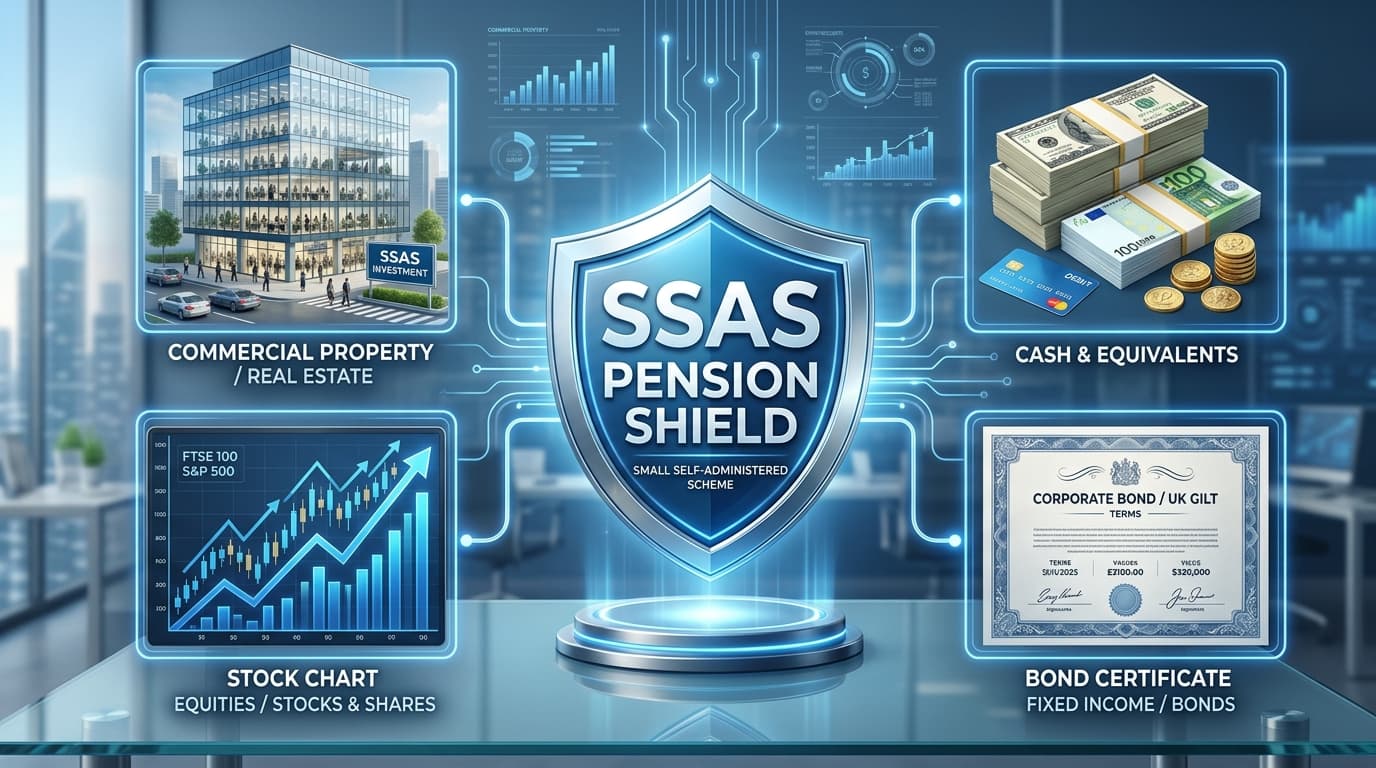
Once funds are within the SSAS, trustees may invest in a wide range of assets including equities, bonds, commercial property, and — uniquely — loans back to the sponsoring employer.
SSAS vs SIPP: Key Differences
The most common comparison is between an SSAS and a SIPP. Both offer self-directed investment, but there are important structural differences. For a detailed breakdown, read our article on SSAS vs SIPP for property investment.
The headline differences are:
- An SSAS is company-sponsored; a SIPP is individually held
- An SSAS can make loanback arrangements to the employer; a SIPP cannot
- An SSAS typically has multiple members pooling funds; SIPPs are single-member
- An SSAS requires a pensioneer trustee; a SIPP does not
- An SSAS can make connected party loans within strict HMRC limits
The SSAS and Commercial Property
One of the most compelling uses of an SSAS is the purchase of commercial property. The scheme can buy commercial premises — including the business's own trading premises — and lease them back to the sponsoring company at a commercial rent. This creates a triple benefit:
- The company pays rent that is tax-deductible, effectively making pension contributions from pre-tax profits
- The rental income accumulates within the pension wrapper, free of income tax
- Any capital growth on the property is free of capital gains tax within the SSAS
Matt Lenzie notes: "We regularly speak to business owners who have been paying commercial rent for years, enriching a landlord, when they could have been building equity within their own pension scheme. The sale and leaseback or direct purchase route can be genuinely transformational for a business owner's retirement planning."
To learn how to fund a commercial property purchase through your SSAS, visit our SSAS property finance page or use our SSAS mortgage calculator to model the numbers.
SSAS Investment Powers
Beyond property, an SSAS can invest in:
- UK and overseas equities (listed and unlisted, subject to restrictions)
- Fixed interest securities and gilts
- Collective investment schemes and unit trusts
- Insurance company managed funds
- Bank and building society deposits
- Commercial property (UK and overseas)
- Loans to the sponsoring employer (loanback)
Certain investments are prohibited, including residential property (with limited exceptions), tangible moveable property, and loans to members or connected individuals. For a full exploration of investment powers, see our guide on SSAS investment powers.
Tax Advantages of an SSAS
The tax efficiency of an SSAS is substantial and operates on multiple levels:
Corporation Tax Relief on Contributions
Employer contributions to an SSAS are deductible against corporation tax in the year of payment (subject to HMRC's "wholly and exclusively" test). For a company paying 25% corporation tax, a £100,000 contribution effectively costs only £75,000 net.
Income Tax Relief for Individual Contributions
Members receive tax relief at their marginal rate on personal contributions, up to 100% of their UK earnings (capped by the annual allowance).
Tax-Free Investment Growth
All income and capital gains within the SSAS accumulate free of UK tax, creating a powerful compounding effect over time.
Inheritance Tax Planning
Assets within an SSAS fall outside of a member's estate for inheritance tax purposes, making it an effective intergenerational wealth transfer tool.
Who Can Set Up an SSAS?
An SSAS must be established by a UK-registered company. The sponsoring employer must be a legitimate trading business. The members are typically directors and senior employees, though family members who are employed by the business may also be included.
There is no minimum fund size to establish an SSAS, though the costs of running the scheme (pensioneer trustee fees, professional administration) mean that the arrangement becomes cost-effective once the combined pension pot reaches approximately £200,000-£300,000, though schemes are often established below this level when future contribution capacity justifies it.
SSAS Annual Allowance and Lifetime Allowance
Contributions to an SSAS are subject to the standard pension annual allowance, which is currently £60,000 per annum (2025/26 tax year) across all pension arrangements. The lifetime allowance was abolished from April 2024, removing a significant constraint on pension accumulation for high earners.
Carry forward of unused annual allowance from the previous three tax years is permitted, potentially allowing up to £200,000 in a single tax year where the member has not been a pension scheme member previously.
Pensioneer Trustee Requirements
HMRC requires that every SSAS has at least one independent pensioneer trustee — a professional firm authorised to act in this capacity. The pensioneer trustee does not control the scheme but acts as a safeguard, ensuring that investments and transactions comply with HMRC rules and pension legislation.
Pensioneer trustee fees typically range from £1,500 to £3,000 per annum, depending on the complexity of the scheme. This is a small price for the compliance oversight and peace of mind they provide.
How to Get Started
Establishing an SSAS requires specialist legal and financial advice. The process involves:
- Instructing a pensioneer trustee to draft the scheme documentation
- HMRC registration of the scheme
- Opening a scheme bank account
- Transferring any existing pension funds into the SSAS
- Making initial employer and/or member contributions
If you are considering using your SSAS to purchase commercial property, our team specialises in arranging finance for SSAS property acquisitions. Contact us today to discuss your situation or explore our SSAS property mortgage options.
"The SSAS is not just a pension — it is a business financial planning tool. Used intelligently, it can simultaneously solve a business's premises problem, reduce its tax bill, and build the directors' retirement wealth. Very few financial structures achieve all three."
— Matt Lenzie, Former Banker & Corporate Finance Partner
Key Takeaways
- An SSAS is a company-sponsored occupational pension offering unparalleled investment flexibility
- Members are typically also trustees, giving them direct control over scheme investments
- SSAS pensions can invest in commercial property, equities, and loans to the sponsoring employer
- Employer contributions attract corporation tax relief; investment growth is tax-free
- A pensioneer trustee is required to ensure ongoing HMRC compliance
- The SSAS is particularly powerful for owner-managed businesses with commercial property needs
About the Author
Matt Lenzie
Former Banker & Corporate Finance Partner
Matt Lenzie is a former banker and corporate finance partner with extensive experience in pension-backed property transactions. He founded SSAS Property Finance to help company directors and trustees navigate the complexities of commercial property acquisition through Small Self-Administered Schemes.